The network effect: How WhatsApp messaging boosted turnout in Italy
Giorgia Meloni’s defeat in the March 23 referendum on judicial reform in Italy was widely seen as a political setback for the prime minister, signaling resistance to key elements of her agenda and revealing a wide gap between her government’s priorities and broader public sentiment. One key element behind this result was the strong turnout. Digital expert Lorenzo Azzolini explains how a civil-society-driven digital campaign on WhatsApp helped achieve this – demonstrating how personal contacts and direct exchanges can make all the difference by amplifying messages exponentially.
The context
In just a few weeks, the referendum on justice reform transformed from a technical issue into a referendum on Prime Minister Giorgia Meloni and her government. Polls showed the two sides very close and a rather low turnout – below 50%. Without the need for a qualified majority, it was enough to get just one more vote to win.
Organizzazione Studio Agitazione and Ultima Generazione, two civil society organizations, showed what they are made of and organized themselves to make a significant contribution: mobilize their activists to bring out as many people as possible to vote.
The plan was simple, to be executed in a few weeks and almost without economic resources. Convince as many people as possible to join two WhatsApp communities created specifically for the campaign and train those people to create broadcast lists, and be ready to send thousands of messages in the week before the vote.
If 4000 of us convince 15 people among our friends and family to vote ‘no’, we can shift 60.000 votes.
The execution
The first step was to recruit the core subscribers. This already amounted to a significant mass of people. Luckily, both Ultima Generazione and Organizzazione Studio Agitazione have built up active digital communities. They sent a series of recruitment emails to their contact list. In just a few days, the two communities were populated with about a thousand people each.
The second step was to convince the people who had already joined the community to send messages to friends and ask them to join the community. In less than two weeks, more than 3000 people had joined the campaign.
Approximately 10 days before the vote, all efforts were focused on training this community of digital activists to create broadcast lists and be ready to share the campaign messages with friends and family.
An online call was organized to explain the theory of change and the potential impact of the campaign, and to help people create their lists and send out a first message. A video tutorial was created to reach people who couldn't participate in the call.
To keep the communities engaged and to offer them different types of content to share, all possible tools were used: audio and video directly from WhatsApp, but also graphics and ready-to-share posts.
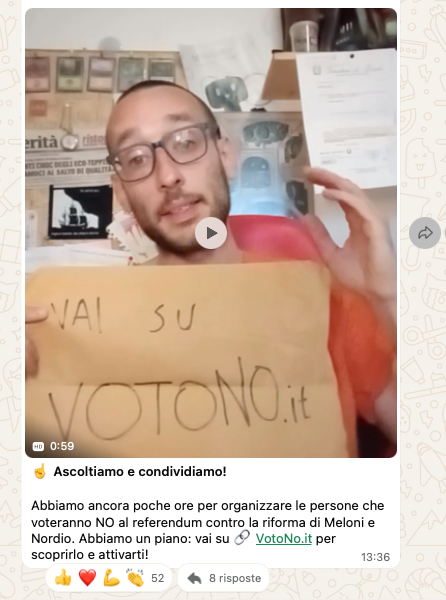
A tool like Sosha has been useful for creating ready-to-use toolkits to distribute to activists.

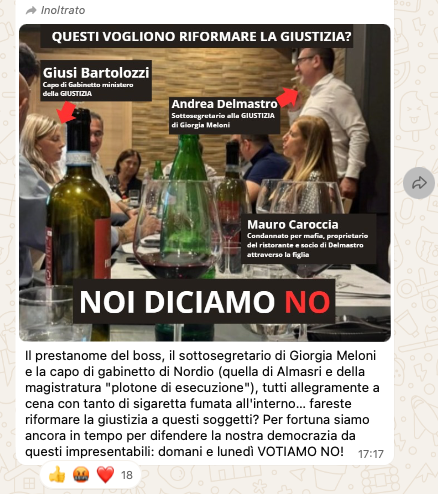
As with any campaign, it is important to leverage current news and use it to create mobilization. A few days before the vote, Deputy Minister of Justice Andrea Delmastro, a member of Meloni’s far-right Fratelli d'Italia and very close to the prime minister, was involved in a scandal when it emerged that he co-owned a restaurant with the daughter of a man convicted of mafia crimes.
These people want to reform the justice system?
The photo shows Delmastro with the minister of justice's chief of staff having dinner in the restaurant co-owned by the mafioso's daughter. The CTA (Call To Action) is an invitation to share the message in the 24 hours before the vote.
The results
After years of Meloni and her party seeming difficult to beat, they have suffered a clear defeat. Not only did the 'no' win the referendum with 54% of the votes (while the 'yes', supported by Meloni, received 46%) but the turnout was incredibly high, around 60%, making this referendum very close to a general political vote.
The result was driven by younger voters, with 61% of 18- to 34-year-olds voting against Meloni.
The impact
WhatsApp is not an ideal tool to trace stats and data and monitor the full outreach of your actions. But what we do know, is that more than 3000 people joined these communities and generated more than a thousand posts on social networks and about 10.000 click-to-shares on WhatsApp. Action data is speaking very loudly.
Understanding how to organize activists using WhatsApp is increasingly important, and this latest case in Italy proves it. In a world of fake news, content generated with artificial intelligence, and algorithms that govern social networks, it is important for people to be able to trust. And the most effective tool to convince people to vote is always a 1-to-1 conversation, which has even more strength if it is between friends or family members.
The most effective tool to convince people to vote is always a 1-to-1 conversation
Organizing a community of digital volunteers, committed to convincing 10-20 people each, who can then in turn convince a further 10- 20 people can certainly be tiring. But losing is also tiring. Investing efforts in organizing, mobilizing and activating your communities can massively pay off, as this example from Italy shows.
To dive further into Whatsapp organizing and how it can boost your outreach and campaigning, join ECDA’s WhatsApp intensive training with Lorenzo Azzolini on April 21.
Images provided by author, featured image from Ultima Generazione Instagram.
Blog post licensed under CC BY-NC-SA 4.0


Comments