The Croydon Story: How losing an election taught us how to win
Updated: Aug 25
Rowenna Davis, who stood as mayor of Croydon in the elections in May, 2026, tells the story of an extraordinary campaign which touched hearts and changed minds. In the end the mayoralty was won by the Conservative incumbent Jason Perry who beat her by 1% of the vote. Since 1968, the Conservatives have run Croydon for all but 12 years.
This article was originally published by ThinkLabour and can be found here.
Election day began at 7am outside West Croydon station. Addicts were waking up with come downs, competing to reach commuters we were leafletting in the blustery morning light. I used to teach down the road, and people on their way to work stopped to say hello or give us a thumbs up to say they’d already voted. One older resident pointed to a mattress in a doorway and said he’d never seen so many ‘open air users’. I keep one eye on passers-by I can leaflet, and the other on my volunteers.
“Hey - I’ve seen your stuff online,” a boy in school uniform with sandy hair and an oversized backpack stops me. He says he likes my ideas on crime, particularly around here, and asks me what I’m going to do about gangs. It turns out he’s been assaulted twice on these streets. We talk some more and he wonders off, before coming back ten minutes later.
“I just called my dad,” he says. “He’s never voted before. He’s going to vote for you now.”
The Croydon campaign was electric. It was full of stories like these. We didn’t win the mayoralty, but we did something special. We earned trust from people who had given up on politics or never voted Labour. We received support from Reform voters, Greens, non-voters and young people voting for the first time. The Greens went from nothing to almost 20,000 votes, and we still came just over 1,000 votes of winning. We doubled the vote share compared to other areas of the country, emerging as the largest party in Croydon, and one of the strongest in London.
The rest of the world looked in on Croydon from their phones. They celebrated our social media success, and attributed our relative achievements to its power, watching us going viral on a weekly basis with videos taken from the top of buses looking down at decaying town centre sites, or watching us flash mob dance in abandoned buildings. But the truth was more complicated. Social media was never an end; it was only ever a means. It was an instrument; not the music; a vehicle, not a destination. What mattered was not TikTok followers, shares or likes: it was the politics it was channeling. This is the story of how we built it.

"Don’t be a politician. Be a neighbor."
West Croydon station wasn’t just where I started Election Day, it was where I started life in the borough when I got a job as a secondary school teacher down the road. Croydon is London’s biggest borough and has more young people than anywhere else. It’s vibrantly diverse, and the students I taught were talented, challenging and creative. But they also faced huge injustices. Like all teachers, I learnt about the real barriers to learning – family breakdown, overcrowded housing, open drug dealing on the streets, the videos of knife violence online and the phones that were snatched and stolen. In many ways, these young people taught me more than I taught them. I told these stories again and again in the campaign, because they explained my motivation to run for office. We weren’t going to get the best out of kids inside the classroom until we dealt with the injustices outside of it.
A few years later, when my two children were born in Croydon University Hospital, these injustices became even more pertinent to me – as they do to all parents. My girls were three and five during the campaign, and I couldn’t imagine letting them go down the road to buy an ice-cream alone in a few years, let alone walking home at night. Croydon wasn’t safe enough for my kids, or anyone’s. Some people might say that this was self-serving, but I think it was an important part of earning trust. I cared about crime because my kids were growing up on the same streets as everyone else’s – people knew I had a deep, personal interest not just in talking about these problems, but acting on them.
I wasn’t born in Croydon, but I chose to make it my home, and throughout the campaign we leaned into those local and personal connections and my personal stake in the fight to improve our borough. We leaned into my identities as a parent and an educator, as these identities were more trusted than someone known as a politician alone. One of our last leaflets, that was referenced most by residents, was essentially just a huge poster that read: “Mum. Teacher. Mayor.”
Learn the story of your place
Croydon has a sad story to tell. Whilst my husband and I chose to make it our home because we loved the vibrant diversity of the place, the great transport links and relative affordability, the more we listened to our neighbors, the more we felt a huge sense of loss. Croydon had once been the capital of South London. Its beautiful Victorian North End high street had once been the Oxford Street of the south, with huge department stores like Alders, Grants and Kennards attracting international visitors through Croydon Airport.
Christmas time was magically spectacular. But by time I arrived, the most common description I heard about Croydon was a ‘ghost town’. Like many high streets, ours had been eroded by the rise of online shopping and out of town retail parks, and this had been compounded by self-serving developers who had brought up large stretches of land, evicted shop keepers and then built nothing. The only way I could explain this suffering to Westminster journalists was to ask them to imagine taking their grandchildren to Oxford Street and it looking like Gotham City. ‘I haven’t just lost my shops,’ I always remember one woman on the doors saying to me, ‘I’ve lost my childhood.’
Listening to the story of a place is essential. I say ‘story’ not because it is fictional or false, but because they are facts that are also rooted in emotion, character, morality and memory over time. Politics cannot exist without a narrative, and if we want our words to connect with people, they must be grounded in the stories our residents are telling themselves.
The only way to uncover these stories is to listen. When I was thinking about standing for Mayor, I took a few of my most trusted volunteers to do just that. We didn’t target any doors; we went to individual streets and knocked on every door there. We threw away the usual script, and instead just asked the big questions. What do you love about it here? What would you change? And what do you think a Mayor should actually do? Croydon is a diverse place, with Thornton Heath being very different to Coulsdon, but the stories that came back to us up and down the borough were surprisingly similar.
Everyone loved their small corner of Croydon, their neighbors and local amenities, but they felt Croydon town center was a problem – a hotbed of crime and decay that they no longer wanted to visit – and they felt that politicians and the town hall were complicit in that decline. The Council was an expensive adversary; not a force for good. No one in any position of power ever had their interests at heart. No one ever put their interests first. It was from dozens and dozens of these honest, heartfelt conversations that we decided we wanted to do things differently. And so, our slogan and guiding light for the campaign emerged: ‘People First.’
Build a manifesto with all parties and none
There is no single way to build a manifesto. In many local parties, the leadership leads on creating the document, and local Labour party members are sometimes given a say on it. We wanted to do things differently. We wanted to build our manifesto from the bottom up, giving people of all parties and none the chance to have their say. We wanted our manifesto to live up to our slogan of putting People First.
In the year up to the election, we invited thousands of residents to contribute to our manifesto. We held over a dozen meetings across every corner of Croydon, with volunteers dropping invitations through the doors of several thousand residents in each neighbourhood where they took place, from West Croydon to New Addington. At these meetings residents would be split into small groups with tea and marker pens, and asked what they loved about their area, what they would change, and some practical suggestions for action. One member of each group would then feedback to the whole meeting, and I would have fifteen minutes to respond to everything that had been said.
These meetings were often fiercely heated and deeply emotional. Reform voters, Green voters and non-voters often came more than Labour voters, and many felt they had never really had a voice. I remember one woman in a blue jumper standing up and saying ‘I wore this colour for a reason, I’ll never vote Labour, you betrayed us,’ by the end of the meeting, we were embracing, our eyes glistening, as she said she had been given hope. There is something so powerful about being heard. We weren’t listening for the sake of it, we were listening so that we could build our manifesto around their hopes and fears for Croydon and the type of politics they wanted. I could never script my answers, because they were talking to me live in the room, and I was having to respond on my feet and publicly, forcing me to listen deeply. Being heard that honestly, and finding that others in the room shared their most heartfelt concerns, was deeply moving for the residents and for me. By the end of them, I felt these voices and experiences had been somehow built into my bloodstream, I didn’t need to speak with notes anymore, I’d taken them on in some way. In a world where people increasingly seem only to speak to their tribes online, we brought together different views in a room and built common ground. It was raw local democracy at its best.
Use radical credible policy to build trust
A lot of people told us that we shouldn’t waste time preparing for office. Instead, we should focus all of our time on simply winning votes. We rejected that logic, and placed a huge bet on using our time to build a detailed, credible and radical policy agenda. We had just seen the Labour government win office on a platform of ‘Change’, only to get through the door and struggle because they didn’t know quite what that meant or how to do it. We weren’t going to make the same mistake. We took the findings from the Listening Exercises and fundraised to pay a researcher to produce detailed policy papers on the issues that were raised. Over two years, I travelled to Sweden to learn how they’d eradicated gun crime, to Manchester to learn how Andy Burnham had improved skills and employment for young people and to Southwark to learn how they had regenerated large complex sites like Elephant and Castle. We talked to external agencies like Create Streets to build out our plans. A focused policy group met weekly to hammer this out and I took three days out of the campaign to write the manifesto myself.
Even though we didn’t get a chance to implement our manifesto, I stand by this commitment to policy. It was a fantastic way to build trust on the doorsteps and it definitely earned us more votes.
CASE STUDY: FLYTIPPING
People loved hearing our fly-tipping policies on the doorstep. Croydon had become the fly-tipping capital of England, with over 50,000 incidents a year. We regularly attacked the Conservative Mayor for this, reporting hundreds of photos of splitting black bin bags, old mattresses and abandoned fridges blocking prams and wheelchairs and attracting vermin. Residents agreed that this was disgusting, but it wasn’t until we talked about how we could do things differently that people actually started paying attention. One of our most simple and successful policy commitments was Big Skip Days. This commitment would see a big skip brought to an area every few months and enable people to get rid of their bulky waste for free. The more we talked about how we were going to get to grips with a problem, the more people started to believe we might actually be worth voting for. By the end of the campaign, I was doing videos on ‘Ten Ways to Stop Fly-tipping’ that were watched hundreds of thousands of times.
This commitment to policy was, for us, also a very moral duty. I will never forget one door I knocked on in a quiet corner of Crystal Palace. ‘I’ve voted on and off my whole life,’ said the older gentleman who answered the door, ‘But I’m tired of people making promises and then nothing ever changing. I’ll tell you something. I will vote for you, but if you don’t deliver, this is the last time I’m ever going to vote. So, you better do something.’ His words always stuck with me. I believe he represented so many people who are right at the edge of losing all faith, not just in politicians, but in democracy itself. If we’re knocking on doors promising change, we better make damn sure we have a plan to deliver it.
Dare to have big fights
People in Croydon, just like people everywhere, are angry. Justifiably angry. And they need leaders that don’t just get that anger, but feel it and act on it. Too often when politicians win election, they become smaller. Perhaps they feel overwhelmed by the office or pressured by civil servants and budget papers and headlines and stakeholders, but they can retreat, turning to management rather than leadership, relying on meetings rather than missions in a world where everyone becomes a stakeholder and no one is a villain. Perhaps it’s just too uncomfortable to hold the conflict, and easier to be polite.
This bland approach serves no one. Whilst no politician should have a fight for the sake of it, they must have the courage to fight when the people need them to.
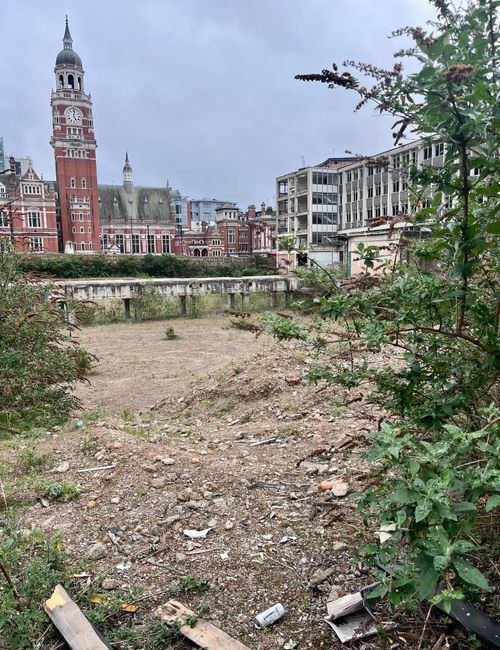
In Croydon, our biggest and most powerful enemy was R&F, a company that we referred to as a ‘corporate squatter’. In the middle of our town center, this company owned a giant plot of land that included the former headquarters of Nestle - now a giant carcass of an empty building, with windows smashed in and walls missing and wires hanging out - as well as St George’s Walk, a beautiful old parade of shops now mostly abandoned and used as a toilet for the homeless. There was literally a ‘hole where our heart should be’ in the town center and no one was talking about it. The incumbent Conservative Mayor had not mentioned these sites publicly in four years of office. The strategy of past politicians seems to have been that this giant barren site was too complex to fix, that the market couldn’t be challenged, and it was better just to put a few flower pots around the edge and call it progress. We knew that getting a site like this moving wouldn’t be easy, but we were prepared to use every single legal power a mayor possessed to fight for the new jobs, new shops and new homes that Croydon residents desperately needed. We broke the conspiracy of silence and called out the company that was wasting our land. Even though we didn’t win, those sites will be much harder for the new Mayor to ignore.
Labour is always strongest when it dares to have big fights like these. A recent article by Patrick Maguire in The Times haunted me. He wrote the current government, ‘engages in arguments without ever making them.’ This is our downfall. The public don’t need politicians to talk around issues; they need leaders to address them. So often we hear talk about the ‘need to have a vision’ and the need to ‘be bold’ and ‘connect with people’ and ‘hold the right to account’ but this is all a meta narrative. We are choosing to evaluate politics instead of doing it.
Put place before ideology
The Croydon campaign didn’t fit into a neat ideological label and it was better because of it. Every policy and position we took was based on the needs of our town. I was proud that it took some radical ideas from the left - not least taking on large corporate squatters wasting land in our town center - but it was not as simple as that. I also said publicly that investors and developers that genuinely wanted to get things done for our town would have no better friend than me and that I’d be willing - in the case of particularly large and complex stalled sites - to lower Section 106 and CIL contributions to be able to get things moving.
The same occurred with crime and anti-social behavior. We committed to a ‘Housing First’ approach to homelessness. This meant not just getting a roof over vulnerable people’s heads, but making sure they had support services around them to get back on their feet, from helping individuals to open a bank account and sign up for electricity to dealing with addiction. Whilst this approach was welcomed by the left, I also publicly endorsed Live Facial Recognition Cameras in the town center. Whilst there were concerns about this from the left, I had met with police and been convinced by the evidence of just how many sexual and violent criminals had faced justice and proper enforcement from this approach.
It is worth noting that putting your place before your ideology doesn’t mean that everyone agrees with you all the time. There were instances where I openly disagreed with voters on the left and the right. But I found that, if you could argue your case with evidence and respect, a lot of people appreciated the fact that a politician was being honest about a disagreement, rather than trying to pander to all the people all the time. In many ways, it helped people trust me more on the areas where we did overlap, because they knew if I didn’t agree, I’d say so.
Finally, it is worth acknowledging that, in Croydon’s case, the national party did give us an unconventional amount of freedom to design our campaign and our manifesto around Croydon, rather than the national party lines. I’m grateful to the General Secretary Holly Ridley and London Region for that and I believe we did better as a result. We did take some risks and occasionally got into trouble, but that I believe is healthy and normal. If you’re not making some mistakes, you’re probably not daring to push the boundaries of politics enough. Our biggest risk is not doing too much, but being too small.
A great mission fuels field
The Croydon 2026 campaign was one of the most happy, joyful places to do politics, at a time when national politics did not feel particularly optimistic. We had a first-class central campaign team led by Ben Taylor and Sam Attwater our organizer. We also had a fantastic slate of candidates, including new, younger council candidates alongside more experienced members, who absolutely drove the votes up in their wards way beyond previous elections, often in areas that were known for very low turnout. Towards the end of the campaign, we were averaging 1,000 conversations with residents a day across Croydon, and we regularly topped the leader board for contacts in constituencies across the country.
I believe a real reason for this energy was a strong, shared sense of purpose with very clear politics. Everyone knew that we were there to put ‘People First’, and that required an outward-focused campaign of public service. Everyone knew by heart our three priorities were the town center, crime and cleanliness. Everyone knew what we were going to do about each of them. We were united in that purpose, as well as having a clear opponent in the form of the incumbent Conservative Mayor. This clear purpose and clear external adversary was unifying, and kept people focused and disciplined and with minimal factionalism or bitching. Of course, there are no campaigns without tension or mistakes, but I genuinely believe our culture was a strong and positive one, and that emerged not so much because of a natural loyalty to me as the candidate or my friendships, but because we had this shared hope in Croydon and its people, and a plan to turn it around.
In one of my happiest memories of the campaign, dozens of candidates of different ages and backgrounds gathered on a Sunday morning to create a flash-mob dance to the Black Eyed Peas in the middle of a dilapidated old shopping parade along St George’s Walk. We had ten minutes to learn the dance and film it. It wasn’t a professional dance and it wasn’t supposed to be; it was supposed to be the people of Croydon taking over a site in decline and filling it with joy, potential and hope. I still have residents talking to me about that video to this day. It was risky, it was different – and people loved it. I remember Cliff Colvin, one brilliant candidate in his 60s going straight out to canvass after we’d finished filming, and continuing to dance up to the doorsteps as he did. As I type this, I still crack into a smile at the memory of the literal spring in his step.
A great message fuels social media
Without a great message, social media adds no value. But once you infuse posts with big arguments about how our home can be a better, safer, happier place to live, it can catch fire. And it did catch fire with us. We were viral every week. It was not unusual to have tens of thousands of views on a post within hours. Even without money on ads, our posts would reach more people more quickly than any local news organization or even TV show. I am sincerely grateful to the work of Marnie Russell and the team at the digital agency 411 for helping us tell our story with creativity and heart, always saying yes to new risky content ideas and adding more.
Social media had been around for previous election campaigns I’d been involved in, but 2026 represented a step change. Almost all news was coming to people online. Everyone who stopped me in the street did so because they had seen me on TikTok, Instagram or YouTube – very few ever referenced the letters we’d sent them via direct mail or the leaflets through their doors. Similarly, there was very little role for the mainstream media. Getting quotes or interviews with local news establishments became impactful if we could clip them and use them on our own platforms, or if they fed into AI searches of our campaigns online. Apart from some very local media establishments, few people would see articles in mainstream news outlets unless they came from us.
Social media also offered an intimacy between myself as the candidate and the voter. When we met in person, you could tell they felt like they knew me because, in a way, they did. They had seen me talking about crime whilst holding the hands of my two little daughters up their high street, they had seen me making a fool of myself dancing outside of their shopping center, they had seen me without make-up ranting in my living room or clearing the fly-tip at the end of their road. They had seen these things on their phones in their bedrooms, next to photos of their children and their lives, talking about issues of huge personal importance, from housing evictions at Delta Point to broken glass in Duppas Hill playground. It was a privilege to be let in that way, and to know that so many of my neighbors cared about these things too. It felt like we weren’t alone in wanting change, and the more authentic and personal I was, the greater the intimacy and the greater the trust with residents who felt the same.
Tell your story, not your opponents’
Our campaign relied primarily on unfiltered communications to residents. By that, I mean we contacted voters directly ourselves through social media or materials we had printed rather than being ‘filtered’ through a publication or news outlet that might edit or change our message. Politics changes when you rely on unfiltered communications this way. It meant that we got to focus on telling our story, and that we engaged less with the various forms of attack that were coming our way. We realized very early on that replying to spurious attacks simply served to amplify them. Yes, there were nasty posts online, but they would receive 10 or 20 views – if we started rebutting them, they were likely to get ten or twenty thousand. This meant that, no matter how unfair or unjustified attacks were against us, we remained disciplined and ignored them, instead telling the story we came to tell about our vision for Croydon.
In general, we found that unfiltered communications were more powerful than filtered. The only exception came from community media stations, for example Iqra TV watched by the Muslim Community, IBC watched by our large Tamil Community and StarRadio by the Ghanian community and Croydon FM. Whilst mainstream news outlets have lost trust amongst residents, we found these community news channels still had a high degree of trust from residents and were well worth engaging in. These channels often offered subtitles and translations into other languages, helping take our message to groups that we would otherwise struggle to reach.
Attract rather than attack the Greens
The strength of the Green vote was a decisive factor in this election. The Greens went from a tiny proportion of the vote in 2022 to having almost 20,000 votes in 2026. It is undoubtedly true that if we had held more of the Green vote, we could have easily won, and that if preferential voting had been allowed again, we certainly would have won. We lost because the left split more than the right.
Early on in the campaign, we made the strategic call not to attack the Greens. I stand by this decision. In my experience on the doorstep, people were not voting Green because they were ideologically wedded to that particular party. They were voting Green because they wanted a bigger politics that was courageous about taking action on social injustice and because they wanted a ‘truer’ expression of change that the national Labour party promised but hadn’t delivered or narrated. I could not attack them for that. Instead, I stressed what we had in common with our green friends, the values that we shared and the policy platform that we’d developed to bring genuine change to the borough.
It is true that there were instances where individual Green candidates could be held to account, but I believe that wholesale attacks on the Green Party as an institution from a Labour Party candidate were unproductive. Residents did not believe they were a ‘nasty party’ or that they were going to ‘legalize all drugs’. Any attempt by Labour to say that looked like a large, authoritarian party trying to snuff out those who wanted more radical action on injustice, thereby proving that the Labour Party was not comfortable with radical politics. This was demonstrated in the Gorton and Denton by-election. I made the decision that it was better to leave other, more neutral message-carriers to carry any attacks rather than to make them ourselves.
Once I’d met a voter on the door, aligned with their values and demonstrated we had a lot in common, I might gently suggest the truth at the end of the conversation that made us distinctive – that we had a credible, well-thought through plan to deliver change in Croydon and that no other party had one to match it. I invited them to compare our plans online and make a judgement for themselves, and asked them only to keep an open mind. Some would not, but others did. I believe we convinced more Greens to vote for us that way than if we’d have gone in for a full-throated attack.
The electorate is bigger than you think
In the last few months of the campaign, I was amazed at the trust we had built. My name recognition had gone from 5% to well over 35%. I couldn’t walk down the road without being stopped. But what was moving was not how many people stopped me, but who. It was the children wanting selfies to send to their parents to ask them to vote, it was the Deliveroo drivers registering to vote for the first time, it was the former Reform voters who were coming back to Labour, the Green voters who were prepared to lend us their vote for Croydon and the young people who were voting for the first time.
It was amazing to think that across the great diverse communities of Croydon, from the mandirs, temples, classrooms, trade unions, workplaces, churches, community centers, colleges, barber shops, newsagents and industrial estates, that they could be united behind this shared politics of hope for Croydon. It made me feel so much hope for democracy. It made me feel that the electorate is bigger than we think, and that we have more in common than we know. Wherever I went with our same message, I’m a mum and a teacher and I want to get our town center back and make it safe and clean again, it was met with people who had those same hopes, and were willing to show up at the polling station in their thousands to take a chance on trusting a different leader. It made me believe we don’t just need to just pander to a small group of median voters; we can have the courage to construct a bigger politics, even if not everyone agrees with it, to go deeper and do more.
And the last thing I’ll say is this. I am so grateful to the good people of Croydon for teaching me these lessons and for sharing your hopes and fears with me. I don’t once blame those people who couldn’t vote Labour this time. I understand. And for all those who did dare to trust us, particularly that young boy who stopped me on election day and dared to call your dad and ask him to vote, you take my breath away and you give me huge hope, not just for Croydon, but democracy everywhere.


Comments