Over 500,000 signatures in 50 days: How an Italian petition became a mass mobilization
In Italy, campaigners succeeded in turning a petition into something much bigger: a nationwide movement demanding a referendum to overturn a controversial law. The new law, introduced by Giorgia Meloni’s government, will block access to sexual and emotional education for many young people and put LGBT+ youth at particular risk of harm and stigmatization.
The campaign received organizational support from Partito Gay LGBT+, which helped coordinate the collection of signatures needed to call for a national referendum to repeal the law. But it rapidly took on a life of its own – becoming a striking example of how digital communication, grassroots organizing, and years of movement-building can combine to create extraordinary momentum.
The campaign manager was Eliodoro Belmare, a political advisor, digital strategist and former ECDA fellow. We spoke to him about how the campaign achieved stunning results – collecting more than 576,000 signatures in just 50 days – and why the secret to its success wasn’t a clever social media strategy, but activating the power of communities, activists, and networks built over many years.
How did this campaign take off so quickly after it was launched?
Eliodoro Belmare: Over the years, we have built a network of people, groups and activists across many Italian cities who had already been involved in our previous political and referendum initiatives. So we were not starting from scratch: we already had hundreds of people who understood the mechanics of mobilization, knew how to spread a signature campaign, activate their local networks, involve associations and local organizations, friends, WhatsApp groups and personal contacts. This allowed us to immediately turn one national campaign into hundreds of local and personal campaigns moving simultaneously across the country.
We had already learned what works and what doesn’t
Equally important was the experience accumulated through previous referendum campaigns. We had already learned what works and what doesn’t, when a signature campaign tends to slow down, how important it is to constantly communicate the numbers, create intermediate targets, make people feel that every single signature can genuinely affect the outcome and, above all, never allow the mobilization to lose momentum. That previous experience shaped the choices we made.
Why was there so much time pressure and how did this shape the campaign?
The 50-day timeframe was particularly challenging. Referendum campaigns in Italy would normally have around 90 days to collect the required signatures, but because the law entered into force on 7 July, the campaign had only about 50 days. This was further constrained by Italian law, which does not allow a request for a repeal referendum to be submitted in the year preceding the dissolution of either of the two chambers. As a result, we found ourselves with an exceptionally narrow window of opportunity, because the law we were seeking to repeal had only been passed a few weeks earlier. Normally such campaigns would have 90 days. But we had to build, launch, and bring a nationwide campaign to the required threshold in less than two months.
We could not afford a campaign that grew slowly.
This also completely shaped our strategy: we could not afford a campaign that grew slowly. Every single day had to generate signatures, shares and new multipliers. This is also where the constant sense of urgency in our communication came from.
How did you convey this sense of urgency in the campaign’s messaging?
One of the central messages was extremely simple: “Stop for a moment. There is something concrete you can do right now, and it only takes two minutes.” At a political moment when many people feel that everything is being determined by the Government’s agenda and that opposition parties have few tools to make a real impact, the referendum was perceived as a concrete instrument of participation. We were not simply asking people to agree with us, to be outraged or to share a post: we were asking them to do something immediately – to sign.
Every day we reported the latest figures. This was another decisive element. People could see the counter rising and understood that their individual action was producing a real result. Every milestone immediately became the starting point for the next one and helped to energize the community even more.
When we reached around 400,000 signatures we told people this could be a decisive moment. The response was extraordinary: in just 24 hours, we got to the required threshold of 500,000 signatures. That showed us clearly the strength of the network we had built: activists, associations, creators, public figures and individual supporters all became active at the same time, each mobilizing other people in turn. It created a genuine multiplier effect and, at the same time, provided concrete proof of how our experience from previous campaigns had taught us to recognize the moment when we needed to accelerate as much as possible.

How did you go about determining a visual identity for the campaign?
This was also a deliberate choice: loud graphics, strong colors, very few words, huge typefaces and a constant sense of urgency. At the beginning, some people even told us that it looked like right-wing communication. The question we asked ourselves was: why should the right have ownership of strong colors, direct language and urgency in political communication? We wanted a simple, clear accessible message so we used those codes without hesitation. Because we are people and we are angry. So the objective was not to create elegant graphics or gentle communication, but to stop people from scrolling and capture their attention.

How did you try to broaden the reach of the campaign and its message beyond the support bases of the organizations who launched it?
From the very beginning, we tried to prevent the campaign from being perceived as one political side fighting against another. People and public figures from the right also signed, and one of our recurring messages was: “Even the people you voted for may not be listening to you on this issue.” We therefore tried to move beyond the usual “left versus right” framework and encourage people to simply ask themselves: “What do you actually think about this issue?”
We decided to collaborate on social media with almost anyone willing to support the campaign, without looking only at follower numbers. In fact, we actively sought out pages, creators and communities capable of taking us outside our own bubble. A small page with an audience completely different from ours could be far more useful than a large account followed by the same people we had already reached.
How did you deal with apathy or hostility towards the campaign?
Perhaps the time has come to move beyond the idea that every absurd or aggressive comment must always receive a polite and institutional response. When we did not want to use harsh language, we used irony. Ridiculing certain arguments, exposing their contradictions and doing so with humor generated a great deal of engagement. People were no longer simply watching the campaign: they began to recognize themselves in its language and in the way it responded.
When we did not want to use harsh language, we used irony.
We also targeted the social media accounts of others. We organized comment-bombing on RAI accounts (Italy’s public broadcaster), asking them to cover the campaign. We also systematically commented under posts by the main opponents of the referendum and then reposted those posts in our Stories, bringing our own community there. In this way, our comment often became one of the most visible underneath their own post: anyone arriving to read the opponent’s content would immediately see our response as well.
The limited coverage from the main Italian media, paradoxically, became an additional driving force. Even today, despite more than 576,000 signatures, the referendum receives very little television coverage, while the campaign has even been reported by foreign media. We therefore turned this lack of coverage into a mobilization tool: “If they are not going to talk about it, then we have to.”

How important were endorsements from public figures, creators, or organizations, and how did you try to achieve these?
At first, many political actors, associations and public figures who were close to the issues of the campaign had remained largely dormant. So we began commenting under their posts, including those of opposition politicians, publicly asking them to take a position. Once the campaign had demonstrated that it had real momentum, many of them gradually began to endorse and promote it.
On our website, we also kept a constantly updated list of all the celebrities, creators, associations, organizations and other groups that had publicly supported the campaign. This also had an important effect: on the one hand, it gave recognition to those who had chosen to take a public stand; on the other, it visibly demonstrated that the coalition supporting the referendum was constantly expanding. Every new endorsement therefore became not only a form of support, but also a tool for encouraging other people and organizations to take a position.
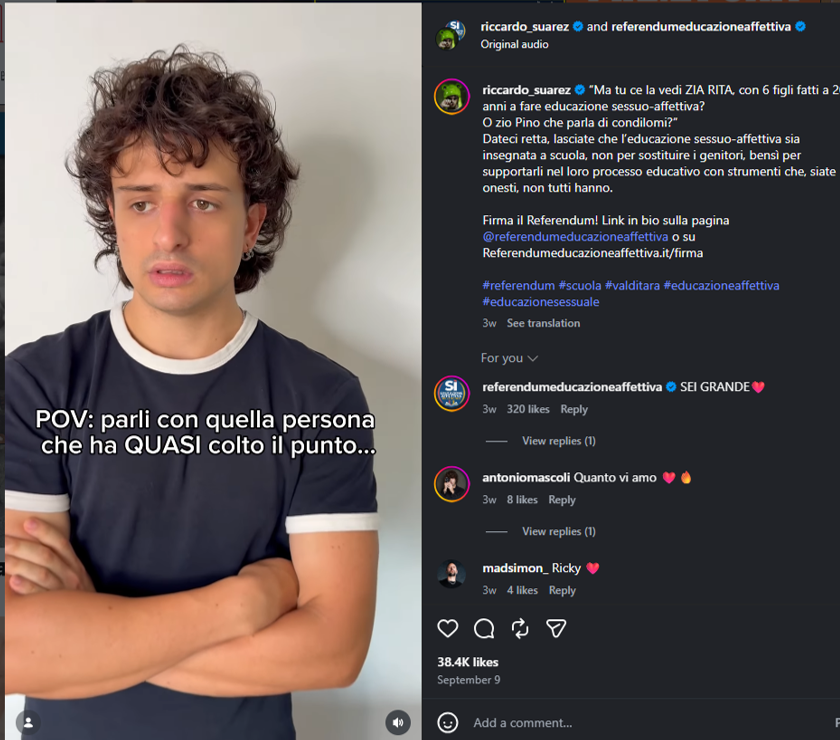
Our collaborations with the stand-up comedy community were also very important. Satire is one of the few tools capable of confronting us with our own contradictions without immediately making us defensive. We therefore worked on light, humorous videos that were often not immediately perceived as “political”, so that people would watch them through to the end and receive the message almost without realizing it.
The involvement of youth associations and the youth organizations of political parties was equally important. Talking about relationship and sexual education without directly involving young people would have been a mistake, so we tried to make them active participants in the campaign rather than simply its target audience.

How did you build mobilization beyond social media?
A grassroots approach was absolutely vital. Following the European ban on paid social advertising, and lacking any mainstream TV coverage or party machinery, ours was the first independent referendum campaign since October 2025 to successfully reach the threshold. We therefore had to rely even more heavily on word of mouth, WhatsApp, mailing lists, newsletters, creators, associations, activists and personal sharing. And this is exactly where the network we had built over the years made the difference: each activist, in turn, became a small hub for spreading the campaign.
What were the overall results of the campaign?
We collected more than 577,000 signatures, allowing us to reach and exceed the 500,000-signature threshold, gained around 100,000 followers and approximately 50 million unique views of the campaign’s content. And all of this happened in around 50 days.
But this result did not come out of nowhere, and it was not simply the result of a successful social media campaign or clever communication tactic. Two elements were fundamental for us: a network of our activists already present and active throughout Italy, and the experience we had gained through previous referendum campaigns. We reached our goals through the combination of political and referendum experience, a nationwide grassroots network, already-mobilized activists, digital communication, creators, associations and hundreds of micro-networks becoming active at the same time.

What are the key things you learned from this campaign?
I think the real achievement is that we did not simply build a signature campaign; we reactivated and expanded a community that already existed and that had developed experience, relationships and mobilization capacity over the years. People spontaneously shared the results, convinced friends and relatives to sign, posted screenshots of their signatures, followed the counter every day and felt that this campaign belonged to them too.
To achieve a result of this scale in 50 days, you need a community that has already been built beforehand.
Perhaps this is the most important lesson of the entire campaign: communication can accelerate a mobilization, but to achieve a result of this scale in 50 days, you need a community that has already been built beforehand. The campaign succeeded in transforming that pre-existing network into participation, belonging and urgency.
What happens now and what are the next steps?
This week (on Tuesday 29 September) we officially submitted the signatures to the Court of Cassation. If everything goes well, the referendum will take place in spring 2027...and at that point, because of the quorum requirement, we’ll face a whole new challenge of mobilizing 20 million people! So even though the petition reached its target, we need to keep campaigning – building our list of supporters and communicating about why this matters so much.
Featured image from the referendum campaign's Instagram feed.
Blog post licensed under CC BY-NC-SA 4.0


Comments